Abstract:
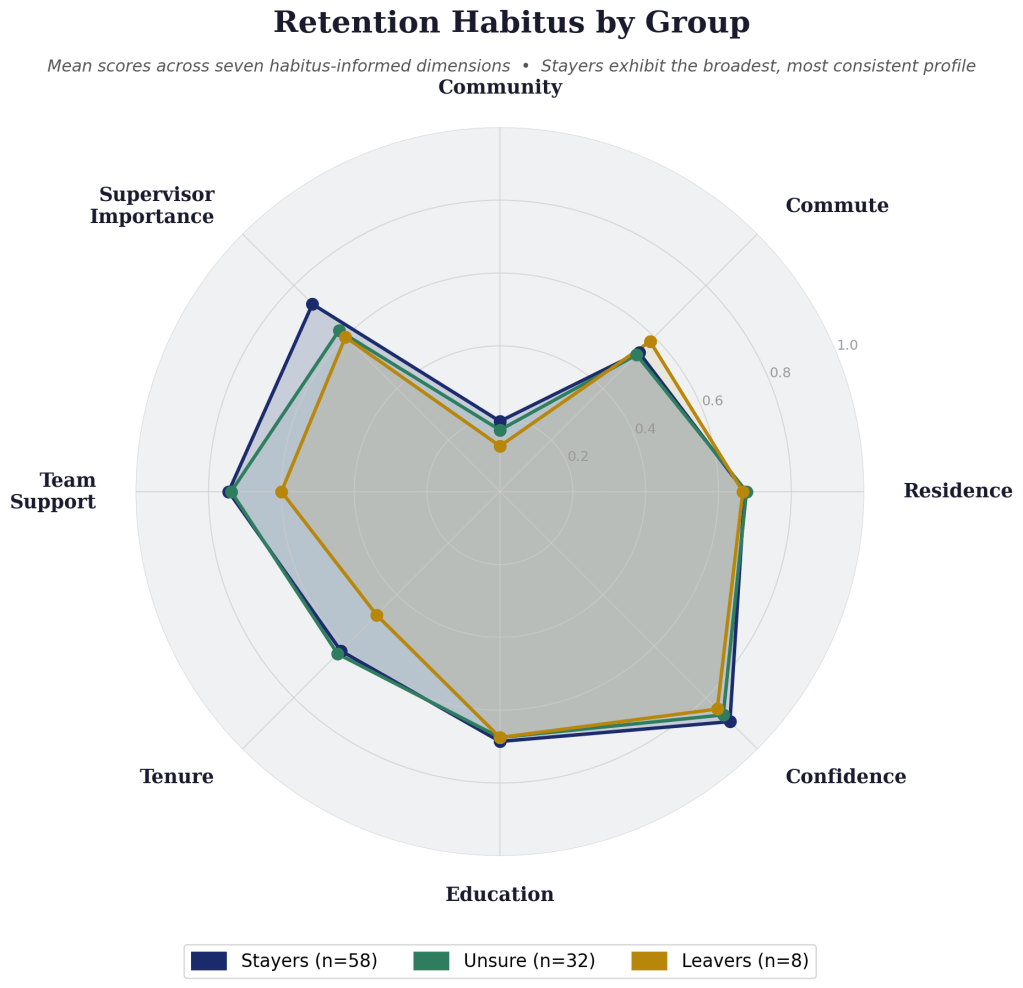
This study examines the factors that sustain long-term nurse retention within RuralCare (pseudonym), a large multi-state Federally Qualified Health Center network serving rural communities across Arkansas, Mississippi, Kentucky, and Tennessee. Rather than focusing on why nurses leave, it focuses on why they stay, revealing the relational and cultural foundations of long-term commitment within a rural health organization. Drawing conceptually from Henry and Hooker’s (2007) framework of rural provider retention and from Bourdieu’s (1977, 1986) theory of habitus and capital, the research integrates mixed methods, including twelve semi-structured interviews and ninety-eight nurse survey responses, within a workforce of more than six hundred. Findings reveal that confidence, lifestyle alignment, community embeddedness, civic involvement, organizational support, and value congruence collectively explain why many rural nurses choose to stay. Retention emerges not merely as an outcome of institutional policy but as a moral and relational fit between nurses and the organization. These results highlight how organizational culture and rural social life reinforce professional stability and suggest applied pathways for strengthening rural health-workforce resilience.
This paper was presented at the Society for Applied Anthropology Annual Meeting 2026 and is currently under review for publication.